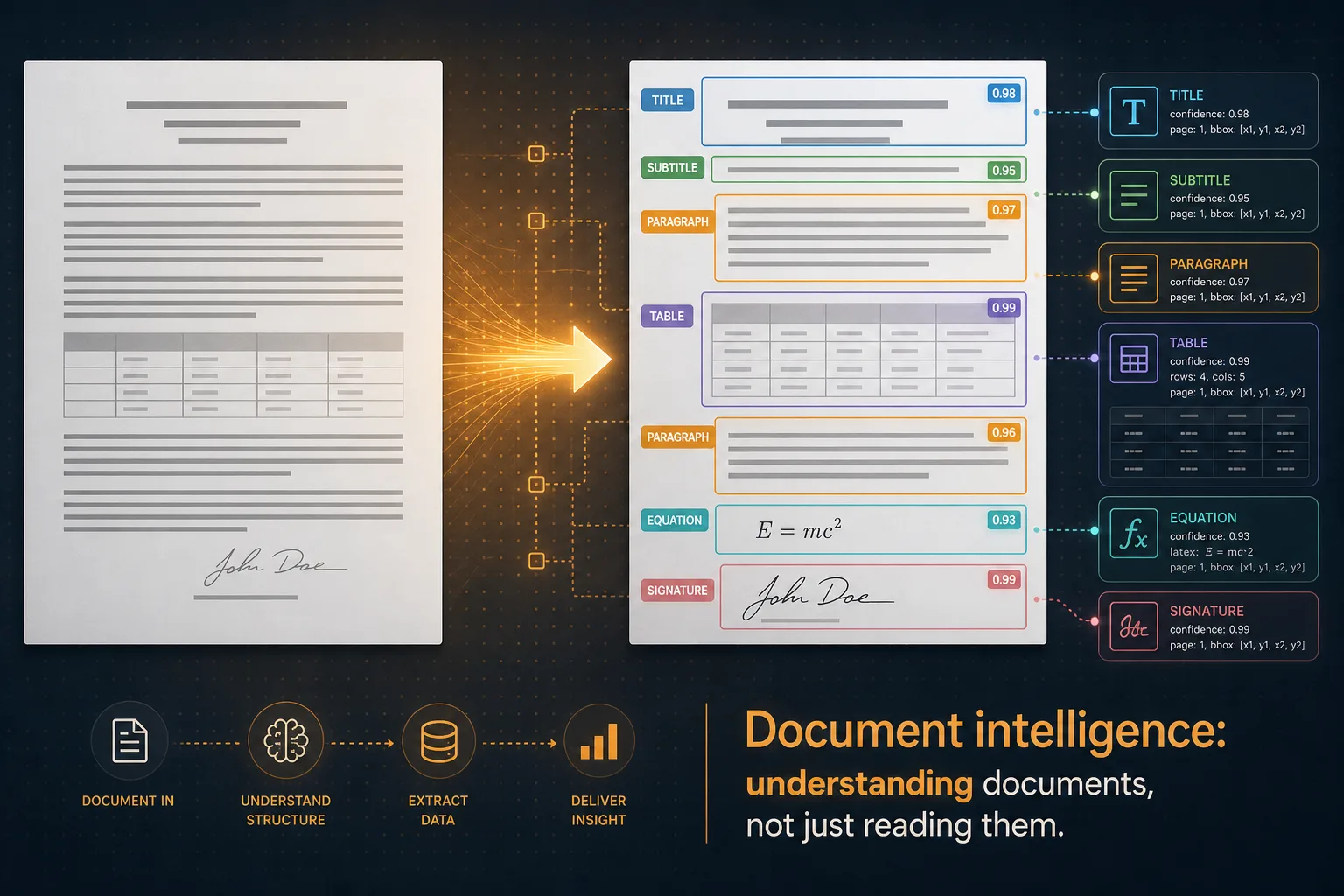
On June 23, Mistral AI released OCR 4, its fourth-generation optical character recognition model in roughly 15 months — and the clearest sign yet that the French lab sees document processing, not chat, as its fastest route into enterprise budgets. The headline shift is conceptual: where older OCR turns a page into a flat stream of text, OCR 4 returns a structured representation of the whole document.
What’s new
Every block OCR 4 extracts now comes back with three extra layers of metadata that downstream systems have historically had to reconstruct themselves:
| Capability | What it does | Why it matters |
|---|---|---|
| Bounding boxes | Localizes each block on the page with coordinates | You know where every element sits, not just what it says |
| Block classification | Tags blocks by type — title, table, equation, signature, and more | Enables structure-aware chunking and routing for RAG |
| Confidence scores | Per-page and per-word certainty values | Route only low-confidence regions to human review |
Mistral frames the model as small and focused: it accepts PDF, DOC, PPT and OpenDocument files, supports 170 languages across 10 language groups (with deliberate gains on low-resource scripts), and always returns the same payload — extracted content, bounding boxes, block types, confidence scores and markdown. A higher-level Document AI layer adds schema-driven JSON output and prompt-based interpretation on top of the same engine.
On the company’s own framing, independent annotators preferred OCR 4 over every system tested, averaging a 72% win rate — though Mistral is unusually candid that OCR benchmarks have known limitations, so treat the number as directional rather than definitive.
Self-hosting is the real headline
The feature most likely to win deals isn’t accuracy — it’s where the model runs. OCR 4 is compact enough to deploy as a single container on an organization’s own infrastructure. That lets banks, hospitals, law firms and public-sector buyers extract sensitive documents without routing a single page through a U.S.-jurisdiction cloud API.
That’s a structural distinction, not a convenience: AWS Textract and Google Document AI are cloud-only. For regulated industries under data-residency rules, an on-prem, structure-aware OCR is exactly the gap Mistral is leaning into — and it dovetails with the company’s broader pitch on European AI sovereignty.
Pricing and availability
| Product | Price | Notes |
|---|---|---|
| OCR 4 (API) | $4 / 1,000 pages | The core model endpoint |
| OCR 4 (Batch API) | $2 / 1,000 pages | 50% discount for high-volume async jobs |
| Document AI | $5 / 1,000 pages | Schema-driven, application-level output |
OCR 4 is available now through the Mistral API, Document AI in Mistral Studio, Amazon SageMaker and Microsoft Foundry, with Snowflake Parse Document support coming soon. Self-hosting is offered to enterprise customers on request.
Why it matters
For Mistral, OCR is a wedge. The model is the ingestion layer for the company’s open-source Search Toolkit (now in public preview), converting raw files into citation-ready, structurally classified input for retrieval-augmented generation and enterprise search. Once a company standardizes on OCR 4 for extraction, the rest of Mistral’s stack — reasoning models and its agentic platform — becomes the natural next purchase.
A few takeaways:
- Document AI is consolidating into the model layer. Bounding boxes and confidence scores used to require a separate vision pipeline; bundling them into one endpoint removes a whole preprocessing stage for teams building RAG and agent stacks.
- Sovereignty is now a product feature, not a slogan. The single-container deployment is aimed squarely at buyers who can’t use cloud-only rivals.
- The economics are aggressive. At $2–$5 per 1,000 pages — and with one early customer claiming comparable accuracy at roughly 8× lower cost than its previous provider — OCR is becoming cheap enough to run across entire document archives.
If you’re mapping where Mistral fits among frontier vendors, see our full AI models directory and the 2026 LLM landscape guide.
A note on the numbers: pricing and availability are as announced by Mistral and reported at launch; benchmark win rates come from the company’s own evaluation, which it acknowledges has limitations. Verify current pricing and deployment options on Mistral’s site before relying on them.
Sources
- Mistral AI — OCR 4: SOTA OCR for Document Intelligence (official announcement)
- VentureBeat — Mistral launches OCR 4, turning document extraction into a full enterprise AI play
- MarkTechPost — Mistral OCR 4 brings citation-ready structured output to RAG and search pipelines
- The Next Web — Mistral OCR 4: cheap, self-hosted document AI